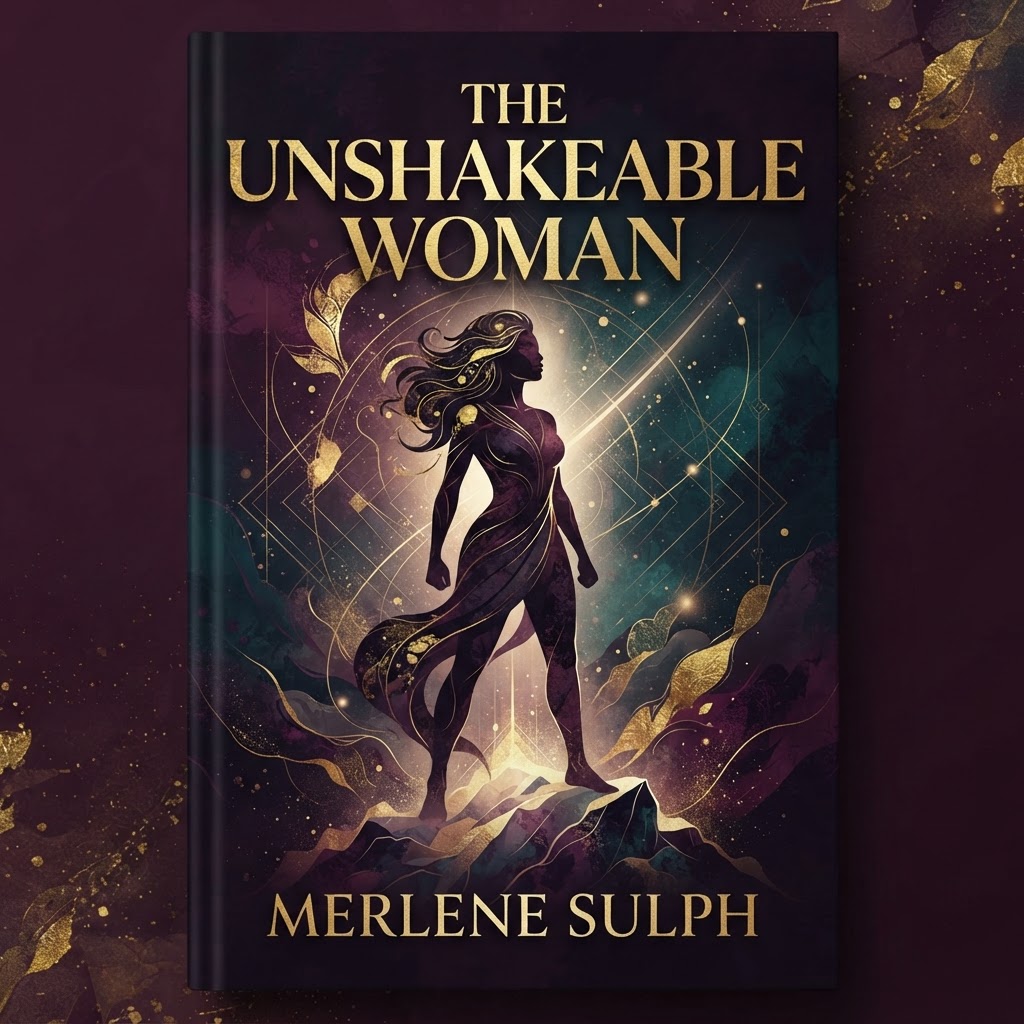
The Unshakeable Woman
A six-module system, a 30-day challenge, and the trackers to prove it worked.
How to use this workbook
Work it in order
The modules build on each other. Module 1 names what shakes you. Module 6 teaches you to rebuild. Skipping ahead means skipping the foundation.
Write by hand if you can
This is a workbook, not a guide. Blank lines are there to be filled. Handwriting slows you down enough to tell the truth.
Do the action step
Every module ends with one thing to do in the real world. Insight you don't act on is just entertainment. The action step is where the change actually happens.
Return to it
Come back to Module 1 after Day 30. Your new Shake List will tell you more about your growth than any feeling will.
The Six Modules
The Shake Audit
You cannot build unshakeable ground on ground you have never surveyed. Before we build anything, we name things. Plainly, without softening them.
Here is what most women discover: it is rarely the big things that shake you. It is the small, repeating ones. The tone of a comment. The silence after you spoke. The invitation that never came. Small things, repeated for years, do more damage than one catastrophe.
So this module is a survey. Not a judgement, not a story about your past — a map of exactly where the ground gives way under you.
The Shake List
Write ten moments from the last twelve months where you felt yourself waver. Beside each, note who was there and what was at stake.
The Pattern Sort
Group your ten into categories. Which category shows up most? Tick it: Approval · Conflict · Comparison · Uncertainty · Loss of control · Being unseen · Money
The Cost Ledger
Take your top three shakes. For each, write what it has cost you — in time, money, peace, or an opportunity you didn't take.
If nothing could shake me, the first thing I would do is…
The disapproval I fear most comes from… and what I've given up to avoid it is…
Circle ONE shake from your list. This is the one you work on for the rest of this workbook. Write it below and date it.
"I name what shakes me so it can no longer run me in the dark."
Roots: The Woman Underneath
Unshakeable does not mean rigid. Rigid things snap. Unshakeable means rooted — and roots are not built in the storm. They are built in the quiet, on ordinary days, on purpose.
Most women can describe who they are in relation to other people. A daughter, a mother, a partner, the reliable one, the strong one. Far fewer can describe who they are when the room is empty and nobody needs anything.
This module is about that woman. She is the one who will hold the line when it costs you something — so you had better know her before the pressure comes.
The Non-Negotiables
Five things that are true about you regardless of who is in the room. Not goals. Not aspirations. Truths that have not changed when your circumstances did.
The Values Sort
Circle five values that matter most: Loyalty · Freedom · Family · Faith · Honesty · Growth · Security · Respect · Adventure · Peace · Recognition · Service · Craft · Health · Independence · Generosity · Beauty · Order · Legacy · Belonging
The Evidence File
Ten pieces of evidence that you have already survived hard things. For each: what happened, what you did, and what it proved about you.
The version of me I perform for others is… The version of me that is real is…
I trust myself most when…
Write your root statement and say it out loud, standing up. "I am a woman who ______, no matter ______."
"I am not built by other people's opinions. I am rooted in what I know is true."
The Voice in the Room
The most influential person in your life has never left the room. She has been talking since you were small, and she has been rehearsing the same lines for decades.
Doubt is not truth. Doubt is a habit. It is a groove worn into your thinking by repetition, and grooves can be re-cut. That is not positive thinking — it is mechanics.
But be careful, because not every inner warning is doubt. Some of it is genuine signal — instinct warning you about a real risk. This module teaches you to tell the two apart, then deal with each one correctly.
The Transcript
Write down five things your inner critic says most often. Verbatim. Exactly as you hear them, including the cruel ones.
Whose Voice Is That
Next to each line, name whose voice it actually is. A parent. An ex. A teacher. A culture. A comment someone made once, years ago.
The Rewrite
For each line, write what you would say to your closest friend in that exact situation. Then read it out loud. Twice.
Doubt or Signal
Sort your five into FEAR TALKING and GENUINE SIGNAL. For every genuine signal, write the practical next step — because that one deserves action, not reassurance.
If I spoke to myself the way I speak to my closest friend, the first thing I would stop saying is…
Take your loudest critic line. Write your rewrite on a card or a note on your phone. Put it where you will see it every morning for the next seven days.
"I can hear the doubt and still move. My voice gets the final word."
Standing Firm Under Pressure
Anyone can feel confident on a good day with kind people. Unshakeable is proven in the room — the meeting, the family dinner, the confrontation you have been rehearsing for months.
Folding is not a character flaw. It is a reflex, learned young, usually because it kept the peace or kept you safe. Reflexes can be replaced, but only with something specific enough to reach for in the moment.
So we are going to build a script bank. Exact sentences, short, no apology attached. When pressure arrives you will not have to invent anything. You will just have to remember.
The Pressure Map
Five situations where you most often fold. Beside each, rate your fold-resistance today from 1 to 10.
The Script Bank
For each situation, write the exact sentence you will say. Short. No apology, no paragraph, no explaining yourself. Start with: "I'm not able to do that." · "That doesn't work for me." · "I need to think about it." · "I hear you. My answer is no."
The Pause Practice
Three seconds. Breathe. Then answer. Log three times you used the pause this week — what you actually said, versus what you would have said on autopilot.
The Recovery Plan
You will fold sometimes. That is not failure, that is being human. Write what you will do in the twenty-four hours after: who you tell, what you say to yourself, how you reset the boundary.
The conversation I have been avoiding is with… and the first sentence I would say is…
Have that conversation within seven days. Write the date you will do it. Afterwards, write what actually happened — because it will not be what you feared.
"I can be kind and still be unmovable. Both are mine."
Boundaries That Hold
A boundary is not a wall. It is a door with a lock you control. Most women do not lack boundaries — they can tell you exactly where the line is. What they lack is follow-through.
Here is the hard truth: a boundary you state but never enforce is not a boundary. It is a preference. And people learn very quickly which of your preferences can be ignored.
The good news is that you only have to enforce it once. One clean, calm follow-through and the ground under you becomes real — for them and for you.
The Boundary Inventory
Four columns. What happened. What I said. What I actually felt. What I will do differently. Fill it in for the last five times you were overrun.
The Consequence Clause
For each boundary, write what you will actually DO if it is crossed. Not what you will feel. What you will do. A boundary with no action attached is a wish.
The Access Audit
Who has access to you? Your time, your energy, your attention, your best hours. Who gets the most? Who has earned it? Who has not?
The Kind No Bank
Five ways to say no that need no explanation. Write them out and practise them until they stop feeling rude.
The person who gets the most access to me and deserves the least is…
If I stopped explaining myself, the first no I would give is…
Enforce ONE boundary this week. Say it once, calmly, then follow through with the consequence. Log exactly what happened afterwards.
"My yes is precious. My no needs no defence."
Rebuilding After the Quake
Let us be honest about what unshakeable actually means. It does not mean nothing lands. It does not mean you stop feeling it. It means the fall is not the end of the story — because you know how to rebuild.
Every woman who has come back from something difficult already has a recovery system. She just may not have written it down. She calls the same person. She goes quiet for a few days. She works harder. She prays. It works, but it is improvised every time.
This module makes it deliberate. Written down, ready in advance, so that the next time the ground moves you are not inventing your recovery while you are inside it.
The Quake Log
The three hardest things you have lived through. For each, what actually got you through? Name it precisely — a person, a practice, a decision, plain stubbornness.
Your Recovery Protocol
The first forty-eight hours. What you do. Who you call. What you do NOT do. Write it as a checklist you could hand to someone else.
The Rebuild Timeline
Name the stage you are in right now: Naming · Grieving · Stabilising · Rebuilding · Rising. Then write what this stage needs from you.
The Letter Forward
Write to the woman you will be in twelve months. Tell her what you are building right now, and what you want her to remember about this season.
The proof I already know how to rebuild is…
Build your Recovery Protocol as a card in your phone or a note in your bag. Keep it where you can reach it in the first hour of a bad day.
"I do not fear the fall. I know how to rebuild."
The 30-Day Unshakeable Challenge
Name it
Name one thing that shook you this year. Write it plainly, no softening.
Do: Say it out loud once.
Root statement
Write your root statement: I am a woman who ______, no matter ______.
Do: Stand up and say it.
Non-negotiables
List five things that are true about you regardless of who is in the room.
Do: Pick one and act on it today.
Catch the critic
Write one sentence your inner critic said today. Verbatim.
Do: Notice when it happened.
The rewrite
Rewrite yesterday's line as you would say it to your closest friend.
Do: Read it out loud twice.
Land it
Say your rewrite three times. What changed in your body?
Do: Write the first thing you noticed.
The unsaid sentence
Write the sentence you have been afraid to say to someone.
Do: Say it to the mirror.
Three seconds
Use the pause in one conversation today: breathe, wait three seconds, then answer.
Do: Log what you said instead.
One clean no
Give one no today with no explanation attached.
Do: Write how it felt afterwards.
Access audit
Who has access to you right now? Circle one person or commitment to reduce.
Do: Reduce it this week.
The consequence
Write the consequence clause for one boundary: what you will DO if it is crossed.
Do: Tell the person once, calmly.
Enforce it
Follow through on yesterday's boundary if it was tested.
Do: Log exactly what happened.
Evidence
Write one piece of evidence that you have survived hard things before.
Do: Sit with it for a minute.
Three more
Write three more pieces of evidence. Be specific about dates.
Do: Read the list back.
Whose voice
Name whose voice your doubt borrows. Write the name down.
Do: Say: that is not mine.
One day
What would you do today if you were unshakeable for one day only?
Do: Do the smallest version.
Halfway honesty
What has been hardest about the last sixteen days?
Do: Tell one person the truth.
The avoided conversation
Name the conversation you have been avoiding and the first sentence you would say.
Do: Book the date in your calendar.
Values check
Pick your top three values. Where did you honour them this week?
Do: Where you did not, name why.
Stop apologising
Write what you are done apologising for.
Do: Do not apologise for it today.
Silence
Sit in silence for five minutes with no phone.
Do: Write what came up.
Deferred decisions
List three decisions you have been deferring. Which is the heaviest?
Do: Choose it.
Decide
Write the decision out in full, as if it were already made.
Do: Write today's date beside it.
The cost ledger
What has waiting cost you? Write it in time, money, and peace.
Do: Act on the decision today.
Recovery protocol
Write your first forty-eight hours: what you do, who you call, what you do not do.
Do: Save it to your phone.
Your stage
Name the stage you are in right now: naming, grieving, stabilising, rebuilding, rising.
Do: Write what it needs from you.
Support
Who are the two people you can call in a bad hour? Write their names.
Do: Tell them they are on the list.
Re-read
Go back to Module 1. Read your Shake List again. What has changed?
Do: Write the honest answer.
The new map
Write a fresh Shake List. Compare it to Day 1.
Do: Notice which shakings lost their power.
Letter to Day 1
Write to the woman who started Day 1. Tell her what she did not know yet.
Do: Keep it. Re-read it in a year.
The Trackers
The Trigger Tracker
Log every shake for thirty days. Patterns will appear by week two — and patterns you can see, you can plan for.
| Date | What shook me | What I did | What I would do differently |
|---|---|---|---|
The Boundary Log
A boundary only counts once it has been tested. Record the tests and the outcomes.
| Date | The boundary | How it was tested | Did I hold? |
|---|---|---|---|
The Wins Ledger
The ledger most women never keep — and the one that changes how you see yourself by Day 30.
| Date | What I did that took nerve | How it felt after |
|---|---|---|
You were never fragile.
You were told you were too sensitive, too much, too emotional. You were taught to keep the peace and call it kindness. None of that was weakness — it was a woman doing what she had to do with the tools she had.
You have now surveyed the ground. You have named what shakes you, met the woman underneath, rewritten the voice in the room, built the scripts, enforced the boundary, and written down how you rebuild.
That is a system. And a woman with a system is very difficult to shake.

